Here’s something we don’t talk about nearly enough in ELT. Listening is one of the skills our students struggle with the most — and honestly, we can’t blame them. During a listening activity, they’re expected to do several things at the same time: decode sounds, process meaning, anticipate what might come next, keep up with speed and accents, and complete a task. To make the challenge even spicier, we ask students to focus on an audio for a few minutes with no images, no gestures, no lip-reading — nada! So if listening feels stressful, discouraging, or “too fast” for them, it makes perfect sense.
If you’re nodding along already, keep on reading so we can uncover some techniques to help our learners enjoy listening activities again.
Traditional listening activities often set students up for a version of listening that simply doesn’t exist in real life. Classic tasks like true/false, gap fills, and multiple-choice tend to push learners into one narrow goal: spotting tiny details while trying to keep up with fast speech, unknown vocabulary, and zero visual support. In consequence, students end up focusing on the task, not on the meaning and the result is a room full of teenagers giving you the classic “Help. Just… help.” face.
And here’s the irony: in real life, native speakers rarely listen this way — So why do we ask our students to do so?
Outside the classroom, we rarely process every single word. We listen to get the gist, to extract key information, to respond appropriately — not to reconstruct verbatim sentences.
Think about how we actually listen:
- We miss words all the time.
- When we’re lost, we use compensatory strategies to fill the gaps.
- We rely on context, body language, tone, prediction, and prior knowledge.
Full Comprehension (for me) isn’t necessary. Even proficient speakers operate with partial comprehension in daily life. What matters is not catching every detail, but being able to understand enough to act.
Many of my learners, especially those who are neurodivergent or who struggle with fine-grained processing, may miss some details, but they still understand the overall message and can respond really well. Forcing them into detail-heavy tasks only increases frustration and decreases confidence.
Instead, we should be helping students develop real-world listening strategies, such as:
- Skimming for general meaning
- Making inferences based on context
- Predicting what might come next
- Tolerating ambiguity without shutting down
These are the skills people actually use outside the classroom — the skills that build autonomy and communicative competence.
If we truly want students to become better listeners, we need to include more process-oriented activities — the kind that develop listening strategies before we test comprehension. In other words, we should help students learn how to listen, not just check whether they understood.
Listening in Layers
One way I make listening a supported process is by teaching it in layers.
For this approach to work, I deliberately choose listenings that are no longer than 3–5 minutes. Shorter recordings allow students to listen several times with different purposes, without overload or boredom.
Each layer serves a different function: first, understanding the big picture; then identifying key information; discussing and clarifying meaning with peers; listening again to confirm or adjust understanding; and, when needed, using the transcript to notice how spoken language actually works and sounds.
When the goal is to teach listening, students should experience all the layers. This repeated, purposeful exposure is what helps them develop strategies, confidence, and tolerance for ambiguity.
When the goal is to test listening, however, I usually skip Pair & Share and Listen & Read. But this only makes sense if students have previously had enough practice moving through every layer in supported listening activities.
You can’t assess what learners were never taught how to do.
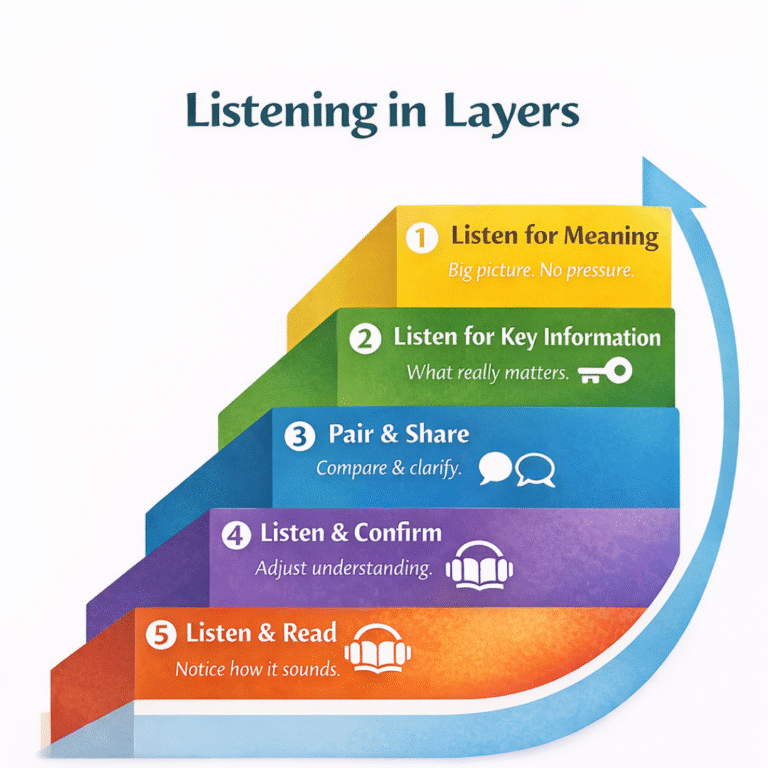
What do students actually do in stages 1 and 2?
During Stage 1 (Listen for Meaning), students might take down notes, jot bullet points or keywords, or even use drawings and symbols to capture what they understand. The focus isn’t accuracy — it’s helping learners make sense of the message in their own way and realize that partial understanding is enough to move forward.
In Stage 2 (Listen for Key Information), tasks become slightly more focused, but still supportive. I often use skeleton texts with some missing words, or short, purposeful questions that guide attention without overwhelming students. Traditional formats like true/false or multiple choice can work at this stage — as long as students are given flexibility. For example, I often allow them to leave one question unanswered or mark an item as “not sure”. This reduces anxiety and keeps the task focused on meaning rather than panic.
All in all, listening doesn’t always fail because students are “not good at listening.”
Very often, it fails because the tasks we design don’t actually help students become better listeners. Too many listening tasks are uninformative: they allow teachers to judge performance, but they offer little insight into why students struggled or how to support them next.
However, when we design listening as a supported process — with purpose, layers, flexibility, and space to make sense of meaning — something changes. Students begin to trust themselves as listeners. They learn that they don’t need to understand everything to understand enough. And that’s when real listening development starts to happen.
So if listening feels hard in your classroom, don’t change the audio.
Change the experience around it.
Because listening isn’t the problem.
The tasks are.
If you believe English teaching should be more student-centered, more humane, and a little more… magical, I’d love to invite you to my Magical Teaching Course (MTC). It’s a space where I share the principles, strategies, and classroom practices I use to design learning experiences that support real communication, confidence, and growth.