

In a world increasingly shaped by artificial intelligence, where information is instantly accessible, and many traditional jobs are becoming obsolete, educators face a critical challenge: How do we prepare students for a future we can’t fully envision? What is the role of the teacher when information is just a click away?
This article invites readers to rethink their role in a landscape of technologically mediated instruction — where learning is increasingly shaped by digital tools. We’ll explore two essential shifts that empower students with the skills they need to thrive in an unpredictable future, and share strategies that promote language development through the use of technology.
So, what does this actually look like in the classroom? It often starts with two simple but transformative approaches
Teaching Students to Ask Better Questions
In human interaction, good questions keep dialogue alive and deepen language learning. In technologically-mediated interaction, the same principle applies: AI can only give meaningful answers when students frame well-crafted questions. Teaching learners to ask better questions equips them to engage critically with people and with technology, turning AI into real partners in language development.
I usually teach my students The Question Formulation Technique (QFT), a structured method developed by the Right Question Institute to help students learn how to ask, improve, and use their own questions to spark curiosity and deepen understanding.
Here’s how it works step by step:
The 6 Steps of QFT
- Present a Question Focus (QFocus): The teacher provides a prompt (it can be a statement, image, quote, or short text). The QFocus is not a question itself but something that sparks curiosity in our learners. Example: “Technology changes the way we learn.”
- Produce Questions: Students work in groups to generate as many questions as possible about the QFocus.
- Improve the Questions: Learners identify which questions are open-ended (require explanation) and which are closed-ended (yes/no or factual). They practice changing closed-ended into open questions and vice versa to see how wording shapes inquiry.
- Prioritize the Questions: From the list of questions, students choose their top 3–5 based on what they find most important, useful, or interesting.
- Plan Next Steps: Finally, students decide how they will use their questions: for research, a class discussion, a project, or an assessment task.
Teaching Critical Thinking through Technology
Instead of banning technology and AI, we should learn to use them mindfully. Through technology-mediated interactions, students can
engage in discussions and projects that foster creativity and critical thinking, transforming technology from a surface-level tool into an active space for inquiry, collaboration, and authentic language practice. It’s not enough to find information—they need to evaluate it, challenge it, and use it wisely.
Now let’s explore some practical activities that foster critical thinking and show how technology can support—not replace—human interaction in the classroom.
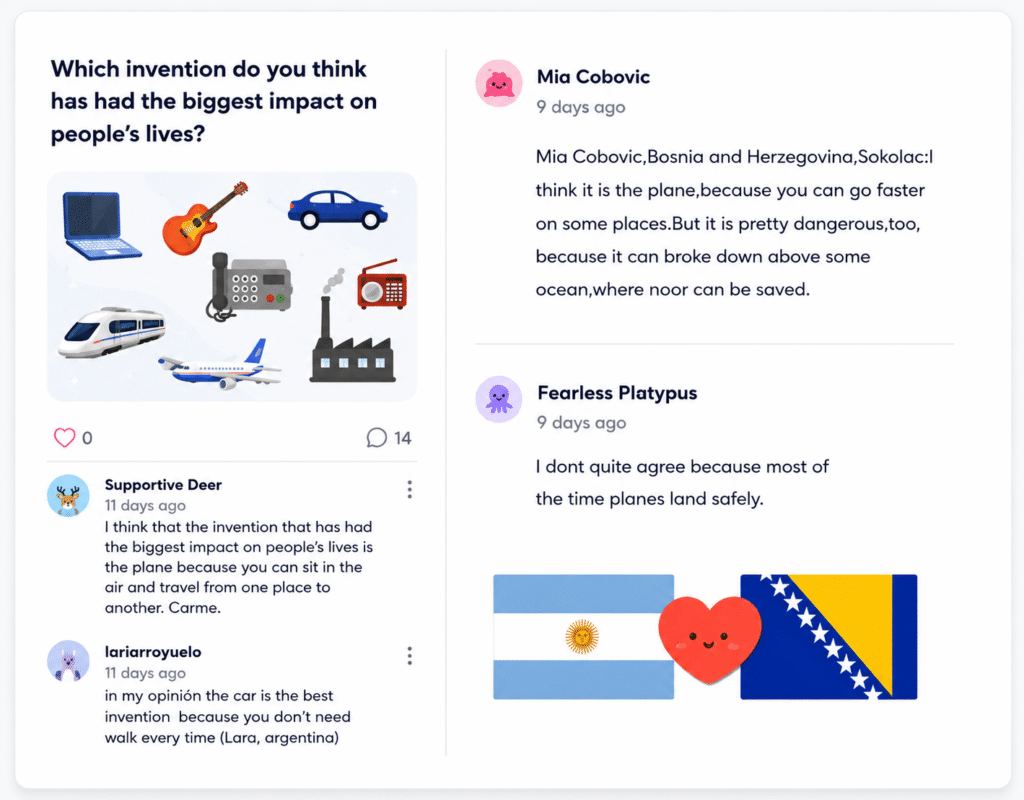
Digital Debate Hub: A Digital Debate Hub is an online space where students can have a discussion by making comments in response to a question provided by the teachers in the hub. Not only do students answer the question, but they also have to comment on their classmates’ posts.
What is great about a digital hub is the opportunity students have to connect with classes from all over the world, which makes the interaction much more enriching and meaningful. My students, for instance, connected with classes from Bosnia and Herzegovina; they exchanged ideas, compared points of view, and expanded their vision of the world.
Teaching Critical Thinking through Technology
Podcast Circles: A podcast circle works like a literature circle but students, instead of discussing a book, listen to a podcast episode and come together to talk about it.
Podcasts are great because students have the chance to listen to natural conversational English, something often missing in coursebooks. They cover real-world issues that can push students to think deeply and form their own opinions about different topics.
Let me explain how a Podcast Circles work. First, the teacher or the students choose a podcast episode to listen to. While they listen, students can jot down quick notes about their main takeaways. The idea isn’t to give them heavy worksheets to complete so they can enjoy the experience of listening to a podcast they like. Then, once the episode is over, they gather in a circle to discuss it.
They can answer questions the teacher prepared, or they can come up with their own. To keep the discussion organized, each student takes on a role: There’s a Leader, who reads the questions and invites people to speak. The Participants, who share their thoughts and opinions. And Note-Takers—two or three students who write down the key points of the conversation. At the end, the Note-Takers hand in their short summaries so the teacher can track their insights and progress.
Student-Led Podcasting: Students can take ownership of their learning by creating their own podcasts. When students create podcasts, they are not only using language but also showing how well they understand a concept, topic, or text.
They must research, plan, write a script, and practise pronunciation — steps that push them beyond memorizing information.
It’s a very complete activity because students develop all language skills. Students become real communicators, not recipients of knowledge but content creators.
Tools they can use to create their own podcasts:
- Phones
- vocaroo.com
- audacityteam.org
As AI becomes more present in our classrooms and our lives, what truly matters is what has always mattered: guiding students to think deeply, ask better questions, and use language to understand the world and express who they are.
AI can support this work, but it cannot replace the human ability to listen, to notice, and to design meaningful learning moments in the classroom. That’s where teachers make the difference because in the age of AI, teaching is not defined by the delivery of information, but by the meaningful learning experiences we design. Our role is to help students not only keep up with change but also question it, shape it, and thrive in it.