
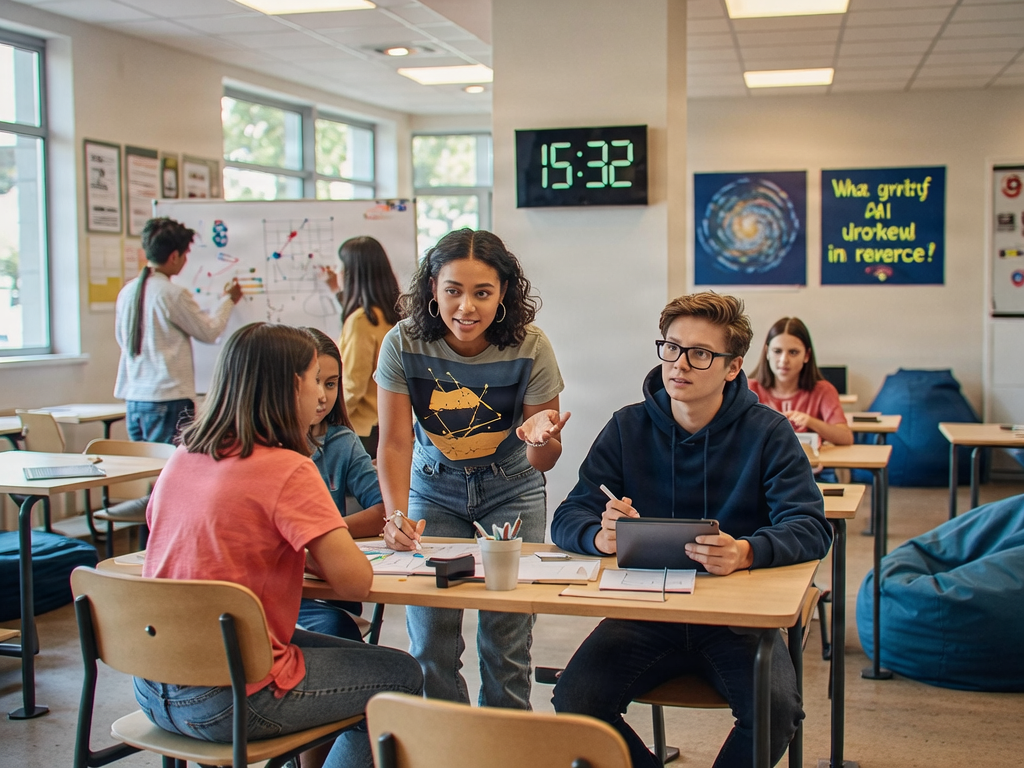
Have you ever felt that, no matter what you do, your teenage students just won’t pay attention?
You bring in a song. Nothing.
A movie clip. Still nothing.
A great reading you were sure they were going to love. Nope.
Sometimes I feel I could turn up to class dressed as a clown and some of my students still wouldn’t notice!
I’ve been there. And every now and then, I still find myself in that place, wondering: What else can I do to make them care?
Over the years, I’ve tried many different things—some successful, some not so much. And that’s probably the first thing we need to accept: there is no magic formula for getting teenagers to focus. What works beautifully with one group might completely flop with another.
But there are a few things that have consistently made a difference in my classes.
So, rather than giving you another list of “attention-grabbing activities”, I want to share some of the principles that have helped me create better conditions for attention in my teenage classroom.
1. Design the environment for attention
One of the biggest shifts in my teaching has been realizing that before asking students to focus, we need to think about the environment we’re asking them to focus in.
We cannot eliminate every distraction, of course. But we can reduce unnecessary ones.
For me, this means minimizing external noise and being very intentional about phones. Unless we need them for a specific classroom activity, phones are not part of the equation. They stay buried deep inside students’ bags—not sitting face down on the desk, not in their pockets, not waiting for the next notification.
But the environment for attention isn’t only about phones.
It is also about the physical classroom itself—and this brings me to something surprisingly simple that has made a big difference in some of my groups.
2. Change the seating arrangement
Where students sit matters more than we sometimes realize.
I started noticing that some students who struggled to concentrate were almost always sitting next to the same person—usually their best friend.
And,the truth is, sometimes your bestie is not exactly your greatest ally when you’re trying to concentrate!
So I started experimenting.
Different partners. Different groups. Different seating arrangements. Sometimes pairs, sometimes small groups, sometimes a completely different classroom layout depending on what we were doing.
The result?
With some groups, simply changing where and with whom students sat noticeably improved concentration.
I’m not suggesting that you separate every pair of friends in your classroom. But if you have students who are constantly distracted, ask yourself:
Could the seating arrangement be part of the problem?
Change it. Observe. Adjust.
Teaching teenagers is often a question of trial and error.
3. Don’t start with the content. Start with curiosity.
Getting students’ attention is one thing. Holding it is another.
One strategy that has helped me enormously is giving students something to wonder about before we begin a reading, a new topic or a new unit.
Instead of immediately saying: “Open your books on page 54.”
I try to give them a question, an image, a dilemma or a little mystery that makes them want to know what comes next.
The question needs to create some kind of information gap: Wait… what?
Why? Could that really happen? What would I do?
Those few seconds of curiosity can completely change the way students approach the content that follows.
I’ve also found that bringing elements of pop culture into these questions can be incredibly powerful—particularly when they connect with something my students are already talking about.
The goal isn’t to make every lesson “fun”. It’s to give students a reason to want to know more.
4. Give them something worth caring about
My students are often at their most focused when they’re working on a project they genuinely care about. And I don’t think that’s a coincidence.
If we want students to invest their attention, projects need to leave room for their interests, passions, and choices.
That doesn’t mean students decide everything. We still determine the learning goals. We still scaffold the process.
We still teach the language and skills they need. But within those boundaries, students can have agency.
They might choose the topic they want to explore. They might decide what content to include. They might choose how to present what they’ve learned.
And suddenly, something changes.
It is no longer only my lesson. It becomes, at least partly, their learning.
And when students care about what they’re creating, we may not need to fight quite so hard for their attention.
5. Make time visible
Another simple thing that works surprisingly well with my teenagers?
Timers.
Whenever I notice that a group is taking forever to get started, conversations are taking over or everyone seems to be doing everything except the task, I put a timer on the screen.
Suddenly, “You have ten minutes to do this” becomes much more real when they can actually see those ten minutes disappearing.
There is something about that countdown that creates a sense of urgency and gives the activity a clear boundary. Instead of a task that seems to stretch endlessly ahead of them, students know:
This is what I need to do, and this is how much time I have to do it.
I use timers all the time, and you don’t need anything fancy. There are loads of free classroom timers on YouTube. I usually project one on the screen and let it run while students work.
I hope you can try some of these ideas with your students — and please let me know if they work! I’d genuinely love to hear what happens in your classroom.
And there is so much more to explore when it comes to teenage attention: curiosity, cognitive load, movement, lesson pacing, transitions, the way we structure learning… and much more.
In fact, I’ll be digging much deeper into all of this in an upcoming webinar on attention and focus in the teenage classroom. I’m still cooking it! 👩🍳 I’m reading, learning, experimenting, and diving deep into an issue that seems to be becoming increasingly complex — and, as a teacher, one that I find a little worrying too.
But more on that soon!
In the meantime, if you’d like to join me for some professional development before the year ends, you can still enrol in my LAST workshop of the year: Pop Culture in the EFL Classroom, on Saturday 17 at 10:30 a.m. (Argentina time).
We’ll explore practical ways of bringing the world our students already know and love into our English lessons to spark curiosity, conversation and engagement.
Will you join me? I hope you will! 💛
👇 Click the button below to register.